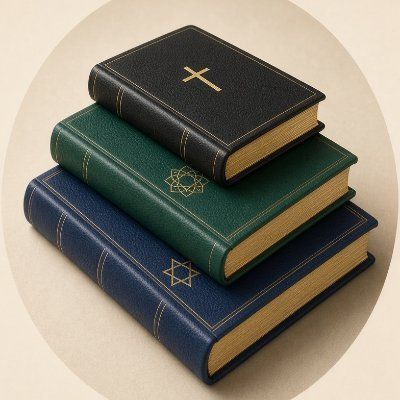
What it is. Its readers call this book the Tanakh. The name is made from the first letters of its three parts: Torah (Teaching, the five books of Moses), Nevi'im (Prophets) and Ketuvim (Writings). The word "Torah" is also used more widely for the teaching of God as a whole. For its readers, this is the record of God making the world, calling Abraham, bringing Israel out of Egypt, giving His teaching at Sinai, and speaking through prophets, poets and sages over many generations.
How it is arranged. The Torah comes first: Genesis, Exodus, Leviticus, Numbers and Deuteronomy. The Prophets follow, beginning with the stories of Joshua, Judges, Samuel and Kings and going on to Isaiah, Jeremiah, Ezekiel and the Twelve. Last come the Writings: Psalms, Proverbs, Job, the five short scrolls (Song of Songs, Ruth, Lamentations, Ecclesiastes, Esther), then Daniel, Ezra–Nehemiah and Chronicles.
Its readers traditionally count 24 books. Samuel, Kings and Chronicles are each one book, Ezra and Nehemiah are one book, and the twelve shorter prophets are one book, called "the Twelve." Many English Bibles divide the same material into 39 books, in a different order. Nothing is added or left out; only the count and the order differ. On this site, using English numbering, that comes to 39 books, 929 chapters and 23,145 verses. Printed Hebrew editions sometimes number verses differently, for example in the Psalms, where a heading can count as its own verse.
Language and age. The book is written in Hebrew, with a few passages in Aramaic, mostly in Daniel and Ezra. Its readers hold that the Torah was given by God to Moses, and that the Prophets and Writings came through the prophets and sages whose names they bear. Many scholars think the books were written, gathered and edited over many centuries, roughly from the early first millennium BCE to the last centuries BCE, using older sources. When the list of books was finally settled is debated; many place it somewhere between the second century BCE and the second century CE.
How its readers use it. The Torah is handwritten on a scroll and read aloud to the gathered community. It is divided into weekly portions, so the five books are read through each year. The reading is chanted to traditional melodies. The Psalms run all through daily prayer. The short scrolls are read on particular festivals and fast days, Esther on Purim for example. Many readers also study the text slowly, verse by verse, with commentaries handed down over the centuries, and they ask what God is asking of them in it.
The translation on this site. We quote The Holy Scriptures According to the Masoretic Text: A New Translation, published by JPS in 1917 ("JPS 1917"). It was made from the traditional Hebrew text (the Masoretic Text), and it keeps the order of Torah, Prophets and Writings. We use it because it is in the public domain, so we can quote it freely and in full, and because it was translated for this book's own readers, in a dignified older English. Newer translations exist, and they are often easier to read.
Where to start.
- Genesis 1–2 (creation)
- Genesis 12 (the call of Abraham)
- Exodus 20:1–17 (the Ten Commandments)
- Deuteronomy 6:4–9 ("Hear, O Israel")
- Psalm 23